



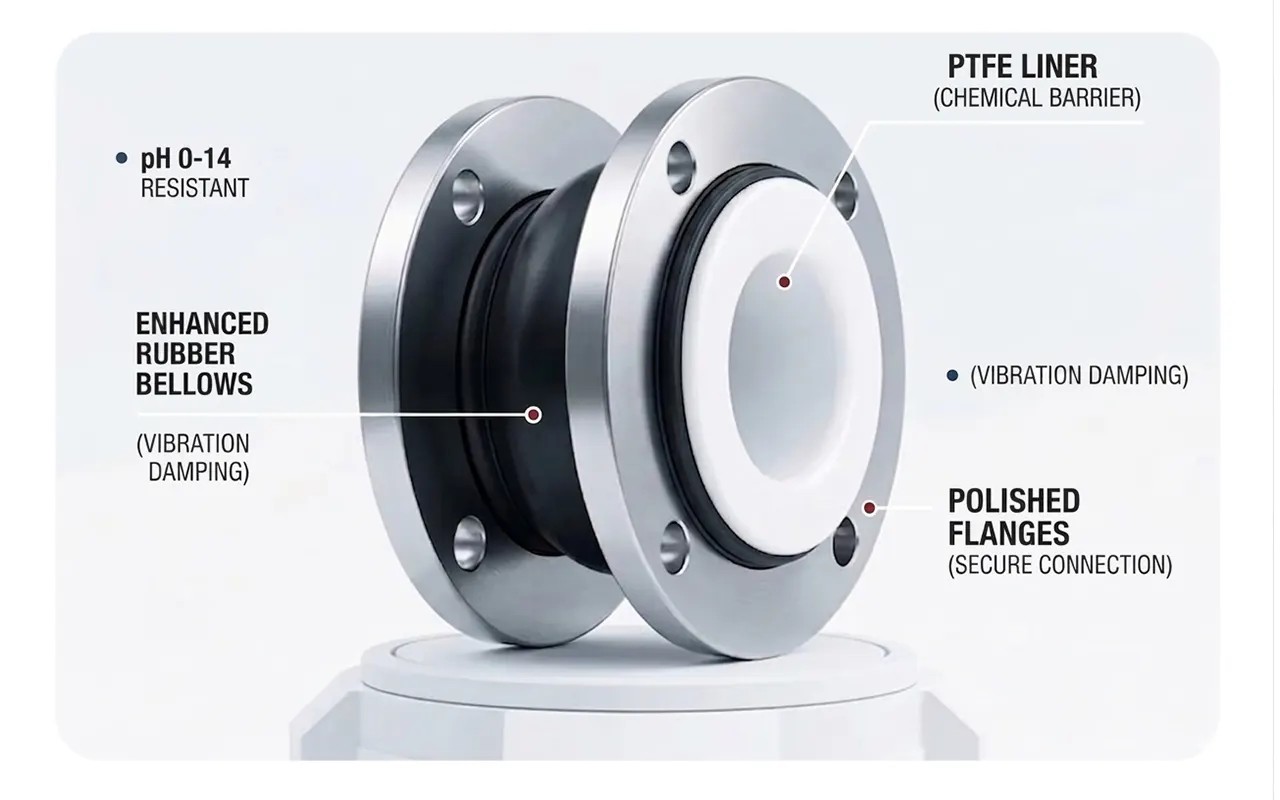
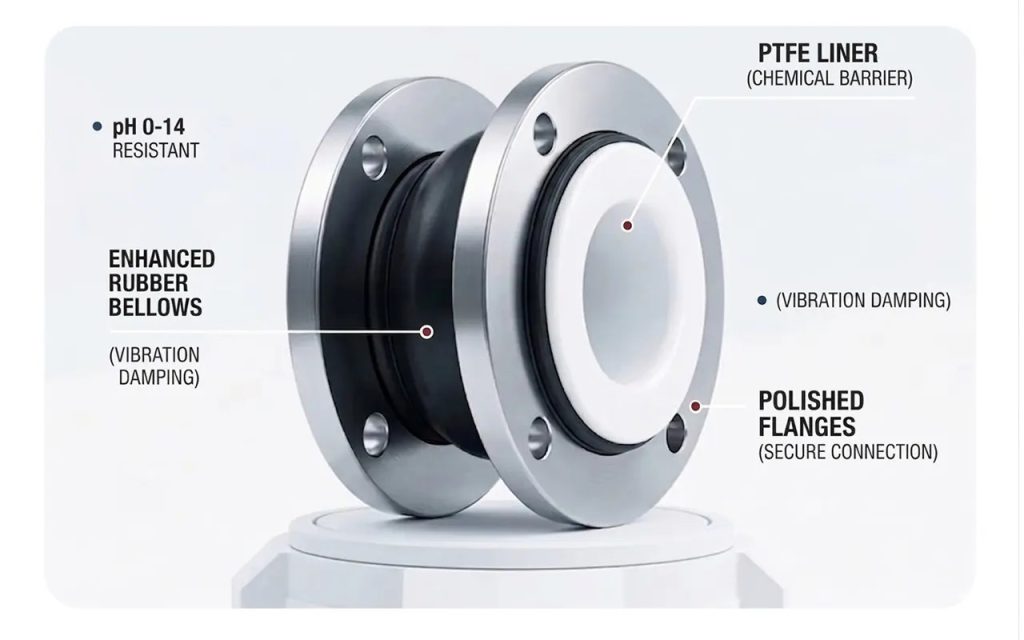
In high-end process chemistry, semiconductor wet processing, and aggressive pharmaceutical manufacturing, piping networks must simultaneously endure extreme chemical attack and high-frequency dynamic mechanical loads. Standard elastomeric flexible connectors, when exposed to ultra-pure concentrated acids, strong alkalis, or aggressive organic solvents, undergo rapid polymer swelling, matrix softening, and premature structural failure. Deploying an engineered PTFE-Lined Rubber Joint (Fluoropolymer-lined elastomeric expansion joint) leverages material synergy, utilizing the absolute chemical inertness of Polytetrafluoroethylene combined with the omnidirectional displacement absorption of a vulcanized rubber skeleton.
1. Extreme Operational Analysis in Aggressive Fluid Loops
Modern industrial processing lines impose dual-stress parameters that standard rigid piping or unlined flexible joints cannot sustain:
- Chemical Permeation and Solvent Reversion: Media such as boiling nitric acid, aqua regia, and concentrated hydrofluoric acid ($HF$) rapidly break down polymer cross-linking in standard rubbers. This chemical degradation leads to localized micro-leaks, environmental contamination, and catastrophic piping breaches.
- High-Vacuum Suction and Bellows Delamination: On the suction sides of chemical dosing pumps, severe negative pressure zones are common. If a PTFE liner is merely loosely inserted into a rubber bellows, the vacuum will pull the lining inward, causing immediate collapse, flow choking, and tearing of the fluoropolymer film.
- Surface Energy and Crystallization Risks: High-viscosity slurries, such as lithium battery cathode pastes containing N-Methyl-2-pyrrolidone ($NMP$), tend to adhere to rough surfaces. Localized scaling and crystallization restrict the inside diameter, increase system pressure drops, and generate severe mechanical friction against the pipeline wall.
2. Technical Performance Matrix: Elastomeric and Fluoropolymer Synergy
| Technical Dimension | PTFE-Lined Elastomeric Joint | Exotic Alloy Metallic Joint | Rigid Standard Lined Piping |
|---|---|---|---|
| Chemical Resistance | Universal (pH 0-14) | Media-Specific (Subject to Pitting) | Universal (pH 0-14) |
| Vibration Attenuation | Superior (Multi-Axis Isolation) | Moderate (Fatigue Sensitive) | None (Transmits Rigid Stresses) |
| Media Purity Control | FDA Grade / Zero Ion Leaching | Risk of Heavy Metal Leaching | FDA Grade |
3. Core Engineering Upgrades of DEVEL Chem-Shield Joints
To eliminate boundary leaks and maintain full pressure integrity under dynamic cycles, DEVEL PTFE-lined composite connectors incorporate verified manufacturing advancements:
Isotropic Molding and Mechanical Interlocking: Rather than utilizing simple sheet-rolling methods, DEVEL utilizes high-density, isotropic molding processes to manufacture ultra-pure virgin PTFE liners. The fluoropolymer material is seamlessly integrated and mechanically locked into the internal convolutions of the high-tensile EPDM rubber carcass. This close structural integration ensures uniform wall thickness and prevents liner separation or collapse, even under full vacuum ratings up to 650 mm Hg.
Seamless Full-Face Flange Flaring: The internal PTFE lining extends continuously through the bore of the single-sphere joint and turns 90 degrees outward across the raised elastomeric sealing face. When clamped against standard companion flanges (ASME B16.5 or EN1092-1), it establishes a direct, secure “PTFE-to-PTFE” sealing boundary. This engineering configuration completely isolates the underlying rubber body and steel backing rings from chemical contact, eliminating the need for separate gaskets and reducing localized leak paths.
Tribological Optimizations and Friction Reduction: Benefiting from the exceptionally low static coefficient of friction inherent to virgin PTFE ($<0.1$), the ultra-smooth internal wall profile minimizes fluid turbulence, reduces localized pressure drops, and prevents particulate matter from settling or scaling within the joint. This smooth bore geometry is critical for maintaining high-purity fluid boundaries in electronics-grade manufacturing.
4. Primary High-Consequence Application Zones
DEVEL premium chemical-resistant flexible connections are specified globally across critical processing infrastructures, including:
- Semiconductor and Photovoltaic Wet Processing: Conveying ultra-pure chemical reagents and high-concentration electronic-grade acids where heavy metal ion leaching cannot be tolerated.
- Lithium-Ion Battery Paste Production: Handling abrasive chemical slurries mixed with highly permeable organic solvents like N-Methyl-2-pyrrolidone ($NMP$) under continuous vibration.
- Industrial Seawater Desalination: Installed on high-salinity multi-stage flash desalination piping loops to completely eliminate localized galvanic corrosion and electrochemical pitting.
5. Quality Assurance and Testing Framework Compliance
DEVEL chemical-shield series composite joints are manufactured in strict compliance with the material and design criteria established by the Fluid Sealing Association (FSA) Technical Specifications and ASTM F1545 plastic-lined piping standards. Quality control protocols enforce 100% factory inspection testing prior to freight loading. This includes certified batch metallurgical tracking, non-destructive Spark Testing up to 10kV to ensure absolute pinhole-free liner integrity, and mandatory hydrostatic pressure testing up to 1.5 times the maximum design continuous operating threshold. All backing flanges are machined with precision bolt configurations matching ASME Class 150/300 or DIN dimensions, utilizing hot-dip galvanized carbon steel or passivated stainless steel.
6. Technical Collaboration and Procurement Mapping
DEVEL is an established manufacturer of high-consequence fluid control structures and advanced fluoropolymer-lined expansion assemblies, focusing on custom application engineering over mass catalog warehousing. Our technical design division provides complete technical submittal reviews, analyzing your piping network’s exact chemical concentrations, vacuum limits, dynamic movement vectors, and purity mandates to engineer long-life PTFE or modified TFM configurations. Project EPCs, plant safety directors, and chemical procurement leads can transmit specialized site datasheets and system layouts directly to our engineering division for rapid compliance verification and technical calculation.