



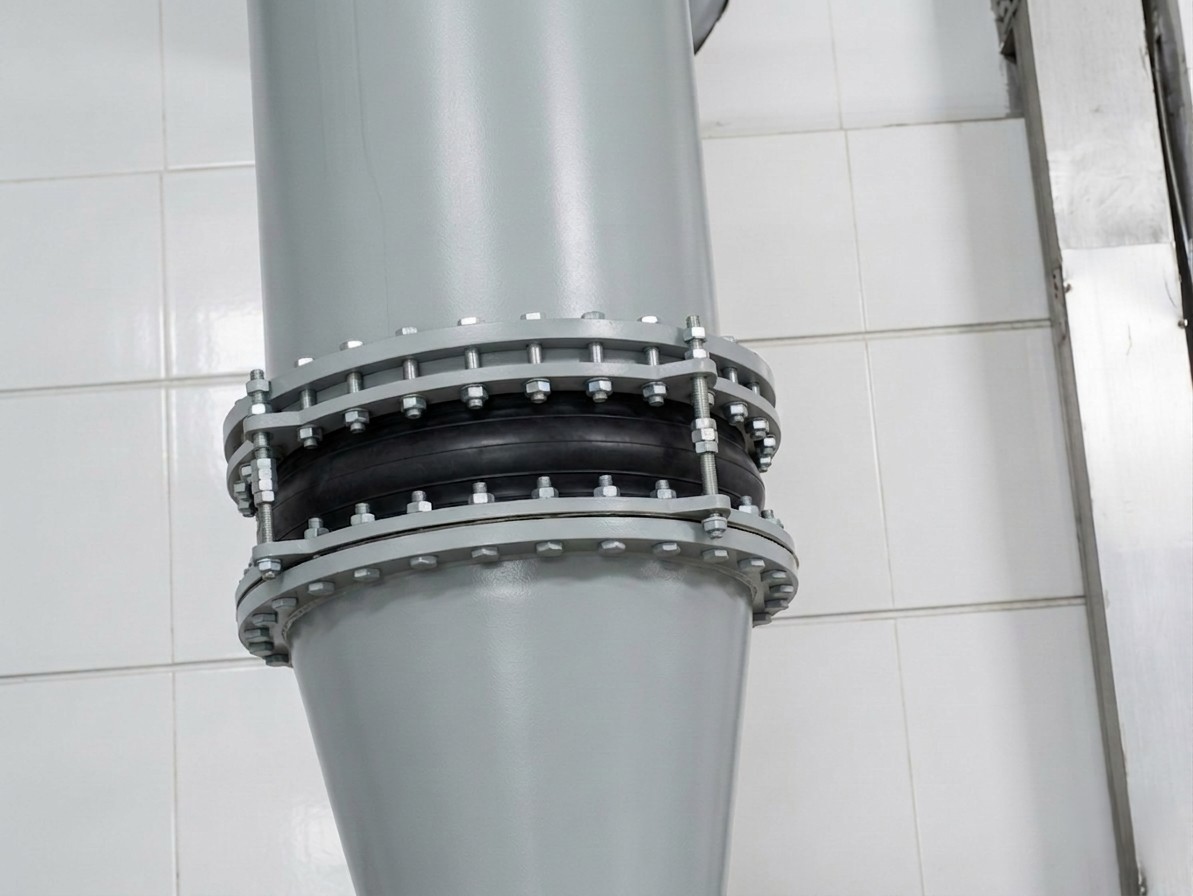
In heavy industrial fluid processing and municipal piping networks, the true cost of a sub-standard Rubber Expansion Joints installation is rarely reflected on the initial commercial invoice. It manifests dynamically in the field via premature bead cracking, flange weeping, elastomer reversion, or unpredicted bellows deformation. While sourcing high-quality engineered elastomers requires a calibrated upfront investment, it guarantees system predictability, catastrophic failure mitigation, and strict compliance with global engineering standards. This technical guide outlines the essential engineering benchmarks required for procurement and quality assurance teams to successfully evaluate, specify, and source heavy-duty rubber expansion joints.
1. Structural Risk Mitigation in Piping Architecture
A rubber expansion joint is fundamentally a flexible pressure vessel engineered to absorb structural stresses within a fluid network. Sourcing personnel must evaluate four primary systemic risks during technical submittal reviews:
- Chemical and Thermal Degradation Risk: The inner tube elastomer matrix must exhibit chemical inertness to the specific fluid medium while maintaining cross-linking stability under peak operating temperatures.
- Hydrostatic and Vacuum Collapse Risk: Pressure ratings fluctuate inversely with temperature spikes. Incorrectly calculated parameters can lead to sudden bellows rupture or internal liner collapse under negative pressure.
- Multi-Axis Displacement Risk: Bellows must possess the necessary convolution geometry to simultaneously accommodate designed axial compression, axial extension, lateral shear, and angular deflection without inducing residual stress on equipment nozzles.
- Installation and Structural Anchoring Risk: A significant percentage of premature component failures stem from uncalculated piping elongation or the omission of necessary control unit assemblies.
2. Key Engineering Specifications for Technical RFQs
To avoid generic or inadequate product substitutions during the bidding process, technical RFQs must mandate the following specific performance boundaries:
I. Elastomer Compound Specification
Generic terminology like “rubber” should be strictly rejected. Sourcing documentation must explicitly dictate the compound classification based on ASTM D2000 standards. Common industrial selections include:
- EPDM (Ethylene Propylene Diene Monomer): Superior for high-temperature water, steam, and ozone-heavy outdoor environments.
- NBR (Nitrile / Buna-N): Mandatory for hydrocarbon processing, oils, hydraulic fluids, and fuel transport lines.
- Neoprene (Chloroprene): Recommended for marine applications, seawater cooling loops, and moderate chemical service.
II. Pressure-Temperature Derating Compliance
The maximum allowable working pressure (MAWP) of an elastomer degrades non-linearly as temperature climbs. Procurement engineers must ensure that compliance with FSA (Fluid Sealing Association) technical handbooks is documented. For instance, a standard single-sphere joint rated for PN16 at 20°C may experience severe structural degradation if operated at that same pressure near its 115°C thermal limit without high-tensile synthetic reinforcement (such as DuPont Kevlar or aramid fabrics).
III. Vacuum Service Configurations
Negative pressure zones, particularly on pump suction flanges, can cause the inner liner of a standard rubber joint to separate from the structural reinforcement layers and collapse inward, choking fluid flow. If negative pressure exceeds 650 mm Hg, the RFQ must explicitly specify the integration of internal, solid stainless steel (SS304/SS316) vacuum support rings embedded directly within the bellows convolutions.
3. Standardization Matrix: Flange and Movement Parameters
| Specification Field | Standard Compliances | Critical Sourcing Checklist |
|---|---|---|
| Flange Drilling | ASME B16.5 Class 150/300, EN1092-1 PN10/PN16/PN25, JIS B2220 | Verify matching bolt hole circles, flange thickness, and materials (Carbon Steel, SS304, SS316). |
| Structural Control Units | FSA Technical Handbook Standards for Restraint Rod Assemblies | Mandatory when piping systems lack solid structural anchors to absorb pressure end thrust. |
| Hydrostatic Margins | Burst Pressure Test Margin ≥ 3:1 (Safety Factor of 300%) | Require factory hydrostatic pressure test reports signed by certified quality control personnel. |
4. Mandatory Quality Assurance Documentation Package
To ensure total field reliability and eliminate unapproved material substitutions, the procurement contract must dictate that the manufacturer submits a complete quality-assurance document package prior to shipment release. This package must consist of:
Certified Submittal Drawings: Detailed dimensional blueprints defining exact Face-to-Face (FxF) lengths, flange thicknesses, and explicit individual layer material callouts (Tube, Cover, Reinforcement fabric, Flange retention rings).
Mill Test Reports (MTRs) and Batch Testing: Documented proof of elastomeric compound testing, including durometer hardness, tensile strength, elongation at break, and continuous hydrostatic testing data verifying compliance with the 3:1 burst safety factor.
Standardized Installation Protocols: Manufacturer-verified torque limit tables for cross-bolting patterns, alongside axial alignment tolerance boundaries to guarantee that field contractors do not utilize the flexible joint to force misaligned piping sections into place.
5. Engineering Heritage and Technical Review
DEVEL is an established manufacturer of high-pressure fluid control components, specializing in custom elastomer engineering and heavy-duty industrial piping integration. Our technical division does not offer generic catalog parts; we perform rigourous cross-examinations of flow velocities, particle sizes, and chemical variations to manufacture single-sphere, double-sphere, and concentrated fabric-reinforced joints tailored to specific plant parameters. Sourcing teams may submit engineering submittals and complex RFQ criteria directly to our industrial design division for technical evaluation and structural optimization.